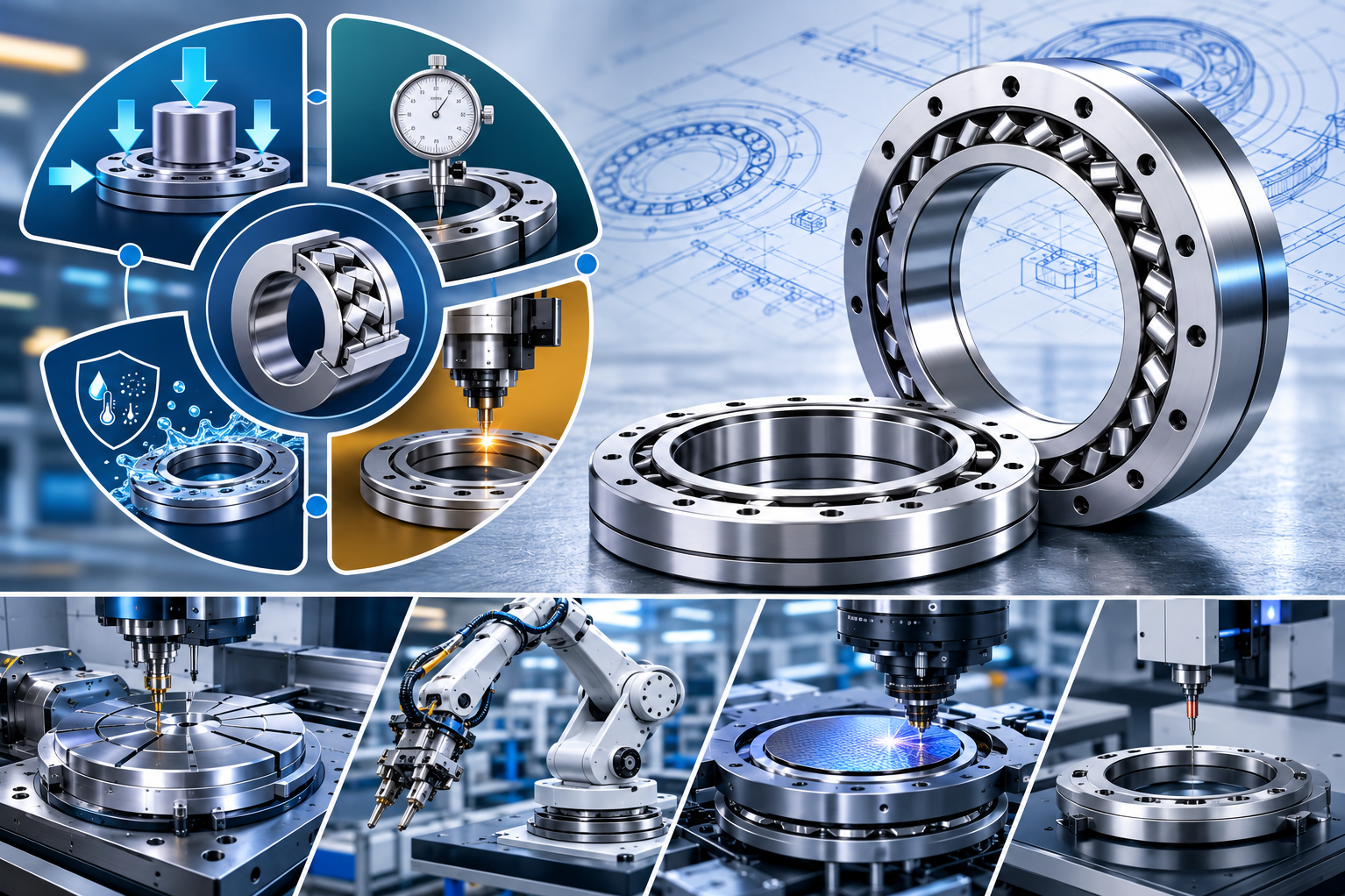
When a machine requires precise rotational movement with minimal deflection, the bearing selection becomes critical. Crossed roller bearings are engineered to handle radial, axial, and moment loads simultaneously, making them a preferred solution for applications where accuracy cannot be compromised.
Rather than choosing a bearing based only on dimensions, evaluating these four factors can help ensure long-term performance.
1. Load Direction and Capacity
Crossed roller bearings are designed to support loads from multiple directions. Understanding the operating load helps in selecting a bearing that delivers stable performance without excessive wear.
2. Rotational Accuracy
Applications such as CNC rotary tables, robotic arms, semiconductor equipment, and measuring instruments require precise motion. A high-quality crossed roller bearing minimizes runout and contributes to better positioning accuracy.
3. Operating Environment
Dust, moisture, temperature, and lubrication conditions all influence bearing life. Choosing a bearing that matches the working environment helps maintain reliability and reduces unexpected maintenance.
4. Manufacturing Quality
The precision of rollers, raceways, and assembly directly impacts bearing performance. Well-manufactured crossed roller bearings provide smoother motion, higher rigidity, and improved service life under continuous operation.
At Bharat Machine Tools, crossed roller bearings are manufactured to meet the requirements of precision engineering, automation, and advanced machine tool applications. Designed for high rigidity and dependable performance, they support industries across Bangalore and Karnataka where consistent accuracy is essential.
Every precision machine is only as reliable as the components it runs on. Selecting the right crossed roller bearing is a step toward achieving smoother motion, higher accuracy, and long-term operational confidence.